Groups Pricing Needs a Profit Lens, Not Just a Revenue One

Maria Gârbea
Senior Product Manager
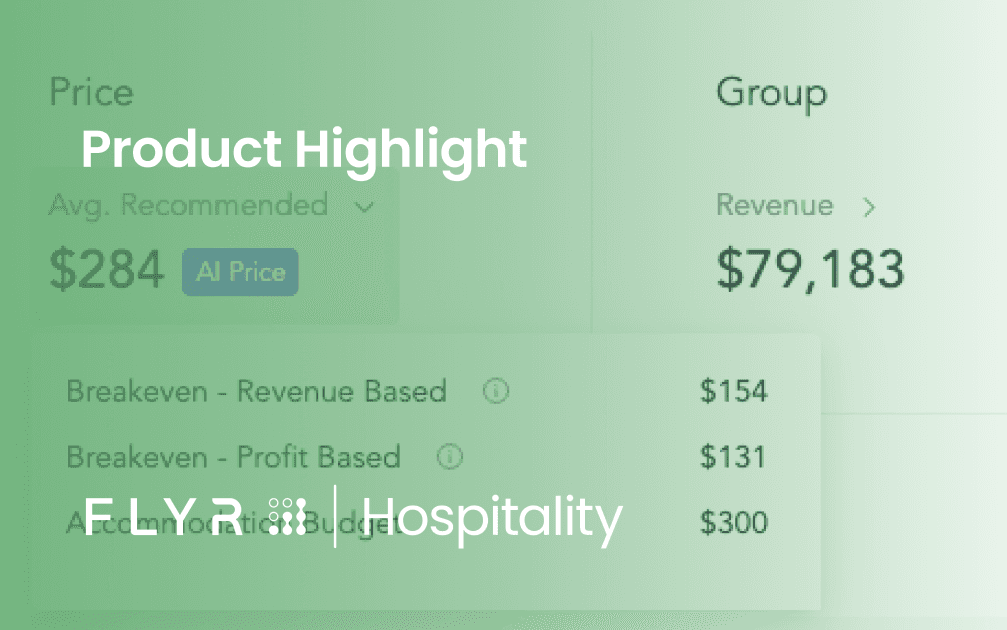
A revenue-only view of group displacement misses channel cost, ancillary margin, and the guests you lose beyond the block itself.
Many group negotiations still come down to one comparison: the room rate on the table versus the room revenue you'd lose by accepting the block. That comparison is incomplete, and it can cost your hotel real money.
A group that looks marginal on revenue can be comfortably profitable once you account for what it actually costs to sell a room through another channel, and what a strong ancillary program adds to the bottom line. The reverse is also true: a group that looks fine on revenue can be a net loss once commissions, channel cost, and lost transient ancillary are applied honestly to the business it displaces.
What should a group displacement analysis actually measure?
Displacement is the potential revenue a hotel gives up from other guests, typically transient, if it accepts a group for the same dates. The standard calculation starts simply:
- Look at capacity for the requested block dates
- Look at what's already on the books
- Forecast the additional transient demand likely to book those nights
- Identify where the group pushes total demand past capacity.
That gives you displaced room nights and, from there, displaced revenue.
The trouble starts once you try to turn that into a pricing decision. A rate that clears displaced revenue on paper isn't automatically a good deal. It ignores three things that materially change whether the group is actually worth taking:
- What happens on the nights just outside the block
- What group ancillary spend is really worth after margin and transient displacement
- What it costs to sell the rooms on either side of the deal.
Why does group displacement need to consider more than just the requested dates?
A group block over Monday through Wednesday doesn't just compete with transient guests who want those exact nights. It also displaces guests who wanted to arrive Sunday and stay through Tuesday, or check in Wednesday and stay into the weekend. Those stays overlap the block without matching it night for night, and a displacement model built around per-night room counts alone will miss them entirely.
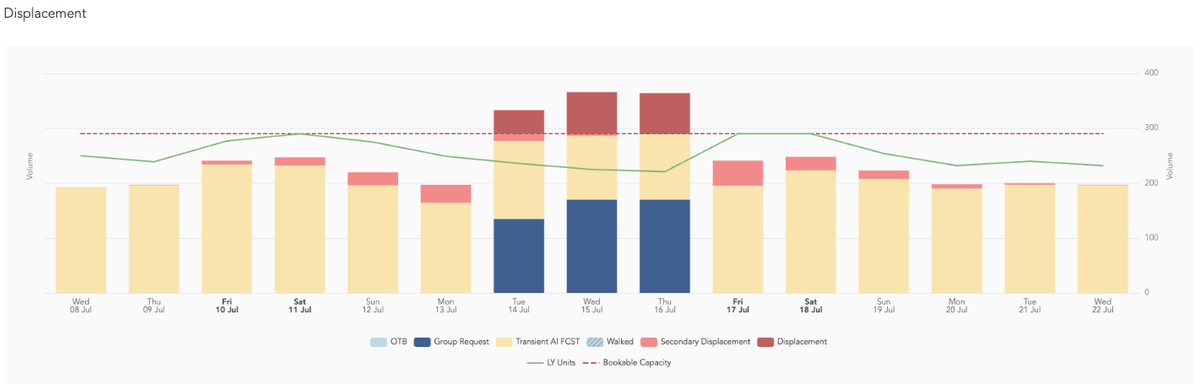
This is secondary displacement, and it matters because group business is rarely priced against a fair comparison unless the model accounts for it. FLYR Hospitality Groups forecasts transient demand by arrival date and length of stay, not just by night, which means it can identify guests who would have stayed through the shoulder nights around a block and were never going to book at all once the group took the inventory. Leave that out, and you understate what the group actually displaces, which pushes your price recommendation, and your negotiating position, lower than it should be.
Why does focusing only on group ancillary revenue fall short?
A group with strong food and beverage, meeting space, or resort fee attachment can be worth taking at a room rate that looks unattractive on its own, because the ancillary contribution is covering the gap. But that only holds up if you're looking at ancillary profit, not gross ancillary revenue.
The same logic has to apply to the guests you're displacing. Transient guests who don't get a room because of the group likely would have spent money on ancillaries, too, and that expected spend needs to be forecast per segment, per night, and run through the same profit margin logic as the group's own ancillary revenue.
Evaluating only the group's top line ancillary contribution, or ignoring displaced ancillary spend altogether, tilts the math in favor of accepting groups that aren't actually as valuable as they look.
Why do both group commissions and transient channel costs need to be factored in?
Every distribution channel has a cost attached to it, and group business typically carries its own commission structure. Comparing a group's headline rate to the gross revenue of the transient business it displaces, without netting channel cost out of the transient side and commission out of the group side, is like comparing your sell rate on an OTA to your sell rate on a direct channel.
Even worse, if you are accounting for group commissions or rebates, but not channel costs of your displaced transient, you are overstating displacement and potentially pricing out a group that you could have profitably accepted.
Why is a profit-based breakeven rate a more complete picture?
FLYR Hospitality Groups runs two breakeven metrics side by side for every group quote: Breakeven - Revenue Based and Breakeven - Profit Based. Together, they answer a broader question than either number does alone: Does this group make sense for your hotel's strategy, and how much room do you actually have to negotiate?
Breakeven - Revenue Based only sees gross dollars on both sides of the ledger. Breakeven - Profit Based sees what commissions, channel cost, and margins actually do to those dollars. A single number cannot tell you what is happening. Only the gap between the two can.
Breakeven - Revenue Based answers: at what room price does this group generate more revenue than the business it displaces? It's built from displaced transient room revenue plus displaced transient ancillary revenue, net of the group's own ancillary revenue, spread across the requested room nights.
Breakeven - Profit Based answers the sharper question: at what price does this group generate more profit than the business it displaces, once commissions, channel costs, and ancillary margins are factored in? It uses displaced accommodation profit (net of channel cost), displaced transient ancillary profit (net of configured margins), and the group's own ancillary profit (net of margins and commissions) to solve for the room rate that clears the bar on the bottom line, not just the top line.
That's a materially different negotiating position than a revenue-only view would ever surface.
How should you actually use the two breakeven numbers together?
Having both numbers only helps if you know what the gap between them is telling you. There are two scenarios, and they point in opposite directions.
When Profit-Based sits below Revenue-Based, ancillary margin is carrying more of the deal's value than the revenue number shows. That gap is real room to be more aggressive on rate than the revenue-only view would suggest, because the ancillary contribution is already doing enough work to protect the deal.
When Profit-Based sits above Revenue-Based, commissions, channel cost, or thin ancillary margins are quietly eating into a deal that looks fine on the surface. That's the signal to hold the line on rate even when the revenue number says there's room to move, because giving up more could mean negative impact to the bottom line that the revenue figure alone doesn’t account for.
Read the gap, not just the two numbers on their own. That gap reflects the combined effect of commission, channel cost, and margin differences across both sides of the deal, and it tells you which direction to lean before you're mid-negotiation.
Want a real-world example? See the FAQ below for a quick walkthrough of the logic.
The practical takeaway
Profit breakeven tells you where the bottom line turns positive, after the real costs of selling a room and running an ancillary program are accounted for. This is your true breakeven, and a powerful datapoint with which to arm your team going into negotiations. It also means that group rate requests can be responded to quickly at volume, with the confidence that any rate provided is grounded in profitability.
When it comes to any displacement analysis that your team is running, check that it is looking beyond the block dates. If it isn't accounting for the transient business that would have stayed through the shoulder nights, both breakeven numbers are working off an incomplete picture of what the group is actually costing you.
That does not mean every group below profit breakeven is a mistake. A property may knowingly accept one to protect occupancy, market share, or a long-term account. The point of running both numbers is making that trade-off a conscious choice instead of a blind spot.
What is not acceptable is not knowing the trade-off you are making. A rate built on an incomplete picture of displacement is a gamble regardless of which way you land on it. Make sure your team is working with the complete picture.
FAQ
What should a group displacement analysis actually measure?
Displaced room revenue on the group dates is only the starting point. A complete analysis also prices in the guests lost on the shoulder nights around the block, the profit margin behind any ancillary spend, and the channel cost and commission attached to both the group and the business it displaces.
Why does group displacement need to consider more than the requested dates?
A group block also displaces transient guests who wanted to stay over those exact dates, arriving before or staying after but couldn't, because the group took the inventory. This is secondary displacement, and a model built on per-night counts alone will miss it, understating what the group actually displaces.
Why does focusing only on group ancillary revenue fall short?
Gross ancillary revenue isn't ancillary profit. A complete picture also nets out the ancillary spend you'd lose from displaced transient guests, forecast by segment and night, using the same profit margin logic applied to the group's own contribution.
Why do group commissions and transient channel costs both need to be factored in?
Comparing a group's rate to gross transient revenue without netting channel cost from one side and commission from the other is like comparing an OTA sell rate to a direct sell rate. Skip either side, and you risk overstating displacement and pricing out a group you could have profitably accepted.
Why is a profit-based breakeven rate a more complete picture?
It answers a sharper question than revenue breakeven: at what rate does this group generate more profit than the business it displaces, once commissions, channel cost, and ancillary margins are applied on both sides. That's the number that reflects what the group is actually worth to the property.
Does a group have to clear profit breakeven to be worth accepting?
No. A property can knowingly accept a group below profit breakeven to protect occupancy, market share, or a long-term account. What matters is making that call deliberately, with both numbers in view, rather than missing it.
What does a displacement analysis that considers profit and displaced ancillary spend look like in practice?
A quick example makes this concrete: A group requests 50 room-nights. The forecast shows 30 of those room-nights would be displaced from transient demand at a $220 ADR, booked through a channel carrying a 30% cost. Those displaced guests would have spent an estimated $30/night on ancillaries, at a 40% margin. The group itself is projected to generate $4,000 in ancillary revenue, at a 70% margin, from a strong banquet and meeting space program.
Breakeven - Revenue Based:
(Displaced room revenue + Displaced ancillary revenue − Group ancillary revenue) ÷ Room nights = ($6,600 + $900 − $4,000) ÷ 50 = $3,500 ÷ 50 = $70/room-night
Breakeven - Profit Based:
(Displaced accommodation profit + Displaced ancillary profit − Group ancillary profit) ÷ Room nights = ($4,620 + $360 − $2,800) ÷ 50 = $2,180 ÷ 50 = $43.60/room-night
The $26.40 gap looks, at first glance, like the group's strong ancillary program doing the work. It is not, mostly.
Split the gap into its two drivers:
Displaced-side effect: ($6,600 + $900) − ($4,620 + $360) = $2,520 → $2,520 ÷ 50 = $50.40/room-night lower
Group ancillary-side effect: $4,000 − $2,800 = $1,200 → $1,200 ÷ 50 = $24/room-night higher
Net: −$50.40 + $24 = −$26.40, matching the gap above.
The channel cost on the displaced business is doing most of the work, worth $50.40/room-night on its own. The group's ancillary margin actually pulls the number back up by $24/room-night, because ancillary profit is always smaller than ancillary revenue. The net gap is small because the two effects are fighting each other. Swap the displaced business onto a low-cost, direct channel, and that $26.40 gap could disappear entirely, even with the exact same group ancillary program. The lesson is not that a strong ancillary program equals a lower breakeven. It is that the gap reflects the full cost and margin structure of the deal, on both sides, and you cannot know which one is driving it until you look.
See FLYR Hospitality in action
Book a demo to see how FLYR Hospitality can drive measurable results for your properties.
Book a demo